
01
Executive overview
Key findings
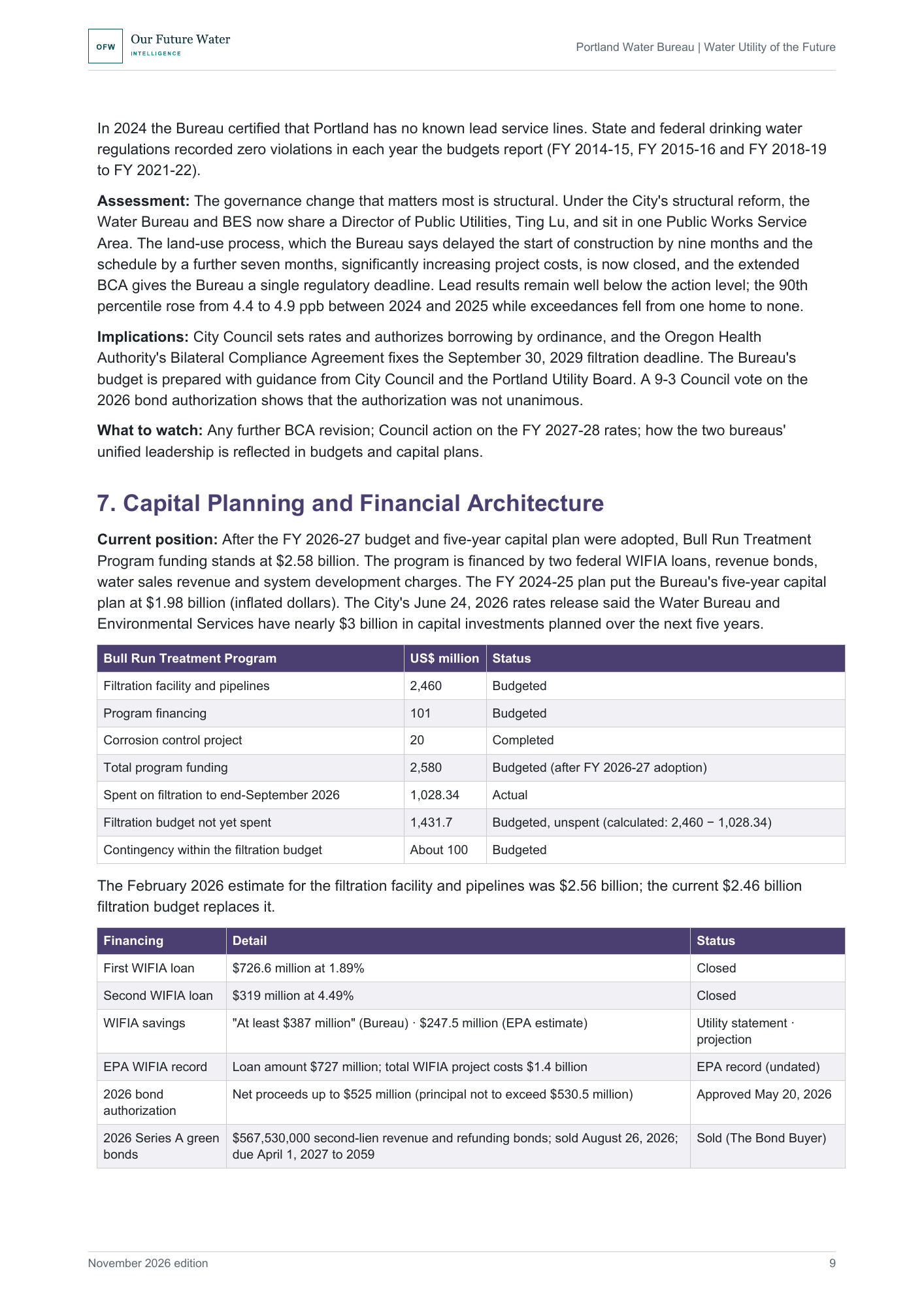
43% complete, $1,028.34 million spent: Bull Run Filtration at end-September 2026, against a $2.46 billion budget; filtered water is required by September 30, 2029
About 114,000 meters: older meters being replaced since March 2026; digital reading activation planned from mid-2027 and full installation by 2030
Half by 2030, net zero by 2050: greenhouse gas targets against a 2007 baseline, backed by a 2024 Net Zero Strategy
$567.53 million: second-lien revenue and refunding green bonds (2026 Series A) sold on August 26, 2026, including refunding
02
Buyer relevance
Who the report is for
Water technology and metering suppliers
Time engagement to the smart meter milestones: digital reading installation from early 2027, activation from mid-2027 and completion by 2030.
Municipal bond investors and analysts
Read the filtration budget, the $567.53 million 2026 Series A green bond sale and first-lien coverage of 7.07 times in FY 2024-25 together with the program's remaining spend.
Energy and decarbonization partners
Size the gap between about 490,000 kWh a year of solar and micro-hydro output and the 4 million kWh renewable goal for 2050.
Regional water agencies and wholesale customers
Follow how the Bureau's rate path, rate study and wholesale departures interact as filtration nears its 2029 deadline.
03
Decision scope
Questions answered
How far has Bull Run Filtration progressed?
At end-September 2026 the project was 43% complete, with $1,028.34 million spent of its $2.46 billion budget; filtered water is required by September 30, 2029.
When will Portland customers see smart meter data?
The Bureau plans to start activating digital reading in mid-2027 and says the first customers will see their own data in late 2027, with installation complete by 2030.
What are the Bureau's carbon targets?
It aims to cut greenhouse gas emissions in half by 2030 against a 2007 baseline and reach net zero by 2050, with a goal of 4 million kWh a year of renewable electricity.
How is the transition financed?
Two WIFIA loans of $726.6 million and $319 million, revenue bonds including $567.53 million sold in August 2026, water sales revenue and system development charges.
04
Inside the report
Inside the complete report
Executive Snapshot
1. From Service Provider to System Operator
2. System Intelligence and Digital Control
3. Energy, Carbon, and Resource Decoupling
4. Infrastructure Strategy for a Non-Stationary Climate
5. Customers, Demand, and the Water Prosumer
6. Governance, Regulation, and Institutional Reform
7. Capital Planning and Financial Architecture
8. Workforce, Capability, and Organisational Change
9. Strategic System Roadmap
Conclusion
Source Register
05
Public preview
What to watch next
2. System Intelligence and Digital Control
The start of the digital reading contractor's work in early 2027; first activations in mid-2027; any water loss figure published for FY 2024-25 or later.
4. Infrastructure Strategy for a Non-Stationary Climate
Filtration construction progress against the 2029 date; a restart decision for the Willamette River Crossing in 2027; completion of the Washington Park site work.
5. Customers, Demand, and the Water Prosumer
The comprehensive rate study's findings; the FY 2027-28 rate proposal, which had not been made as of mid-2026; the timing of TVWD's exit.
7. Capital Planning and Financial Architecture
Monthly filtration spend against the 43% completion figure; rating agency commentary on any further second-lien issue.
Capital Planning and Financial Architecture: the Bull Run Treatment Program budget, WIFIA loans, the 2026 bond sale and credit ratings.
06
Included
What you receive
The complete PDF report: 14 pages, 12 sections, 21 tables and a register of 25 sources.
This edition
November 2026, First edition.
07
Evidence & method
Evidence and method
The report draws on the Bureau's project status, cost and smart meter pages, its Net Zero Strategy and climate pages, City ordinances on rates and borrowing, the City's audited annual financial reports, EPA's WIFIA record, Oregon Health Authority compliance history, drinking water quality reports, and bond market and news reporting from 2026.
Sources
25 sources, listed in the report's source register. Evidence current to 12 November 2026. Principal data periods: Bull Run Filtration progress to end-September 2026; FY 2026-27 adopted rates; FY 2024-25 audited City financial report (year ended June 30, 2025); calendar 2025 lead monitoring; smart meter program status to October 28, 2026. All currency is US dollars..
Evidence boundaries
This report uses authoritative source material available at the stated research cutoff. It distinguishes published facts, calculated values and analytical interpretation. No independent modelling is performed. Forward-looking analysis reflects published plans, documented trends and stated uncertainties. It does not constitute legal, financial, investment or engineering advice.
08
Lead analyst
Robert C. Brears
Founder, Our Future Water Intelligence
Robert C. Brears is a water-security specialist and author whose work examines utility governance, infrastructure investment, climate resilience and long-term water-system change for executive and policy audiences.
- Decision-focused utility intelligence
- Published water-policy author
- Evidence-grounded system analysis
09
Buyer FAQs
Before you purchase
Who can use the report?
Licensed for internal use within one purchasing organization. The PDF and its contents may be shared with colleagues within that organization. External redistribution, resale and public publication are prohibited without permission.
How is the report delivered?
The PDF is available to download immediately after confirmed payment, through our secure delivery system.
Can my organization buy wider access?
Institutional purchasing: For invoice enquiries, multi-organization licensing or broader access requirements, contact Our Future Water Intelligence.
10
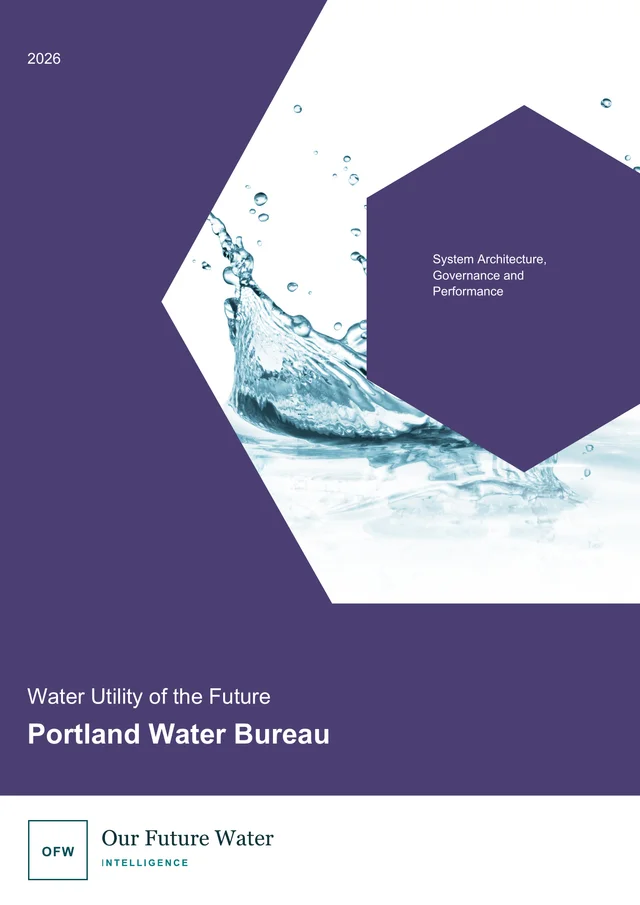
Water Utility of the Future: Portland Water Bureau
- Format
- Length
- 14 pages
- Edition
- November 2026, First edition
- Price
- USD 499
11
Report details
Publication details
- Publisher
- Our Future Water Intelligence
- Report family
- Water Utility Intelligence Report
- Edition
- November 2026, First edition
- Format
- Length
- 14 pages
- Reference
- OFW_EXT_WATER_UTILITY_OF_THE_FUTURE_PORTLAND_WATER_BUREAU_ff19df6112a5
- Evidence current to
- 12 November 2026
14
Explore this report family
More Water Utility of the Future reports
Explore the same report family covering other utilities.
Water Utility of the Future: EYDAP S.A.
- Geography
- Athens and Attica, Greece
- Edition
- November 2026, First edition
- Length
- 16 pages
Water Utility of the Future: DC Water
- Geography
- Washington, District of Columbia, United States; wholesale wastewater for Maryland and Virginia counties
- Edition
- November 2026, First edition
- Length
- 15 pages
Water Utility of the Future
Water Utility of the Future: Thames Water
- Geography
- United Kingdom, Europe
- Edition
- October 2026 edition
- Length
- 15 pages