
01
Executive overview
Key findings
974.17%: freshwater withdrawal as a share of available renewable freshwater (SDG indicator 6.4.2, 2023), the measure of how far use exceeds renewable resources
50%: desalinated water's share of distributed water in 2023, up from 44% in 2022, after desalinated supply rose 31% to 3,785 million m³ (GASTAT)
35%: NWC's non-revenue water (February 2026); reaching its 27% target would save about 0.82 million m³ a day (calculated), more than the 300,000 m³ a day Ras Mohaisen plant will add
2028 to 2030: when the next large contracted supply with published dates arrives: Ras Mohaisen (100,000 m³ a day from 2028, 300,000 by 2030) and the Jubail–Buraydah line (Q1 2029); the Riyadh–Qassim line (Q1 2030) has a preferred bidder but no signed agreement or financial close
02
Buyer relevance
Who the report is for
Desalination developers and equipment suppliers
Compare the 12.8 to 16 million m³ a day of reported capacity with the 18 to 20 million m³ a day targets for 2030 and the plants contracted to close the gap.
Utility planners and operators
Weigh NWC's 35% non-revenue water and its 27% target, worth about 0.82 million m³ a day, against new plant capacity.
Agricultural and food-sector investors
See how far fossil groundwater use has fallen and how much of natural supply it still provides.
Lenders and risk advisers
Review the reliability risks for inland supply: transmission lines of 587 km and 859 km, about 1.9 days of storage and energy dependence.
03
Decision scope
Questions answered
How much of Saudi Arabia's water is desalinated?
Desalinated seawater supplied 3,785 million m³ in 2023, 50% of distributed water and 22% of natural water-resource supply, according to GASTAT.
Is fossil groundwater use falling?
Yes: the Minister reported non-renewable groundwater consumption falling from 21 to 11 billion m³ a year between 2016 and 2025, although it was still 62% of natural water-resource supply in 2023.
When does new contracted supply arrive?
Ras Mohaisen adds 100,000 m³ a day in 2028 and 300,000 by 2030; the Jubail–Buraydah line is due in Q1 2029; the Riyadh–Qassim line (Q1 2030) has a preferred bidder but no signed agreement.
How large are water losses?
NWC reported 35% non-revenue water in February 2026 against a 27% target; national losses were 36% in 2024 against a 15% programme target for 2031.
What are the official supply targets?
Desalination of 18 million m³ a day by 2030 (Minister) or about 20 million (an ACWA Power executive), and about 21 million m³ a day of desalinated urban supply by 2050.
04
Inside the report
Inside the complete report
Executive Snapshot
1. Why This Matters Now in Saudi Arabia
2. Current Position
3. Key Programmes, Projects and Investment
4. Policy, Regulation and Institutions
5. Risks and Constraints
6. Strategic Implications
7. What to Watch
Source Register
05
Public preview
What to watch next
1. Why This Matters Now in Saudi Arabia
The first 2027 desalination tender; any demand response to the 2027 tariff rates.
3. Key Programmes, Projects and Investment
Financial close on Riyadh–Qassim; a Jubail 4&6 purchase agreement; the first 2027 desalination tender; Maee's end-2026 savings against 180,000 m³ a day.
4. Policy, Regulation and Institutions
Publication of the National Water Strategy document or the 2050 plan; SWA's supply-planning outputs.
5. Risks and Constraints
Progress towards the seven-day storage target; NWC's hours of supply against 21.9; any official groundwater-reserve update.
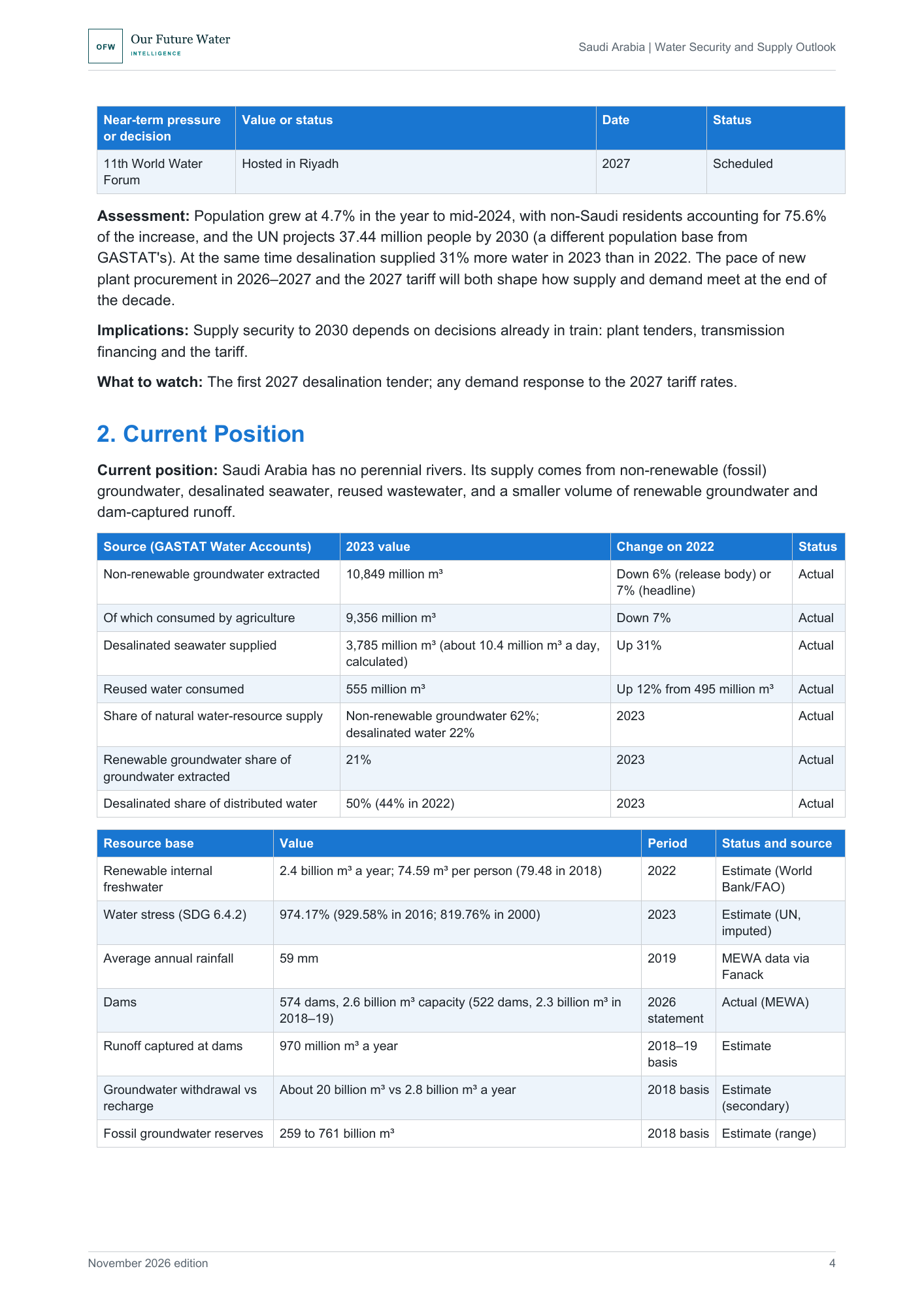
Section 2: Saudi Arabia's water sources in 2023, resource base and demand, with values, periods and status
06
Included
What you receive
The complete PDF report: 12 pages, 9 sections, 12 tables and a register of 39 sources.
This edition
November 2026, First edition.
07
Evidence & method
Evidence and method
The report draws on GASTAT's Water Accounts and population estimates, MEWA and Saudi Water Authority statements, NWC operating data, World Bank and UN water indicators, Sharakat project announcements and Saudi Arabia's Second Nationally Determined Contribution. Project stages were checked on 8 November 2026.
Sources
39 sources, listed in the report's source register. Evidence current to 8 November 2026. Principal data periods: Water supply and use 2023 (GASTAT Water Accounts); resource indicators 2018–2023; operating data to March 2026; capacity statements and project stages to 8 November 2026; targets to 2030 and 2050. Volumes in cubic metres (m³); currency Saudi riyal (SAR)..
Evidence boundaries
This report uses authoritative source material available at the stated research cutoff. It distinguishes published facts, calculated values and analytical interpretation. No independent modelling is performed. Forward-looking analysis reflects published plans, documented trends and stated uncertainties. It does not constitute legal, financial, investment or engineering advice.
08
Lead analyst
Robert C. Brears
Founder, Our Future Water Intelligence
Robert C. Brears is a water-security specialist and author whose work examines utility governance, infrastructure investment, climate resilience and long-term water-system change for executive and policy audiences.
- Decision-focused utility intelligence
- Published water-policy author
- Evidence-grounded system analysis
09
Buyer FAQs
Before you purchase
Who can use the report?
Licensed for internal use within one purchasing organization. The PDF and its contents may be shared with colleagues within that organization. External redistribution, resale and public publication are prohibited without permission.
How is the report delivered?
The PDF is available to download immediately after confirmed payment, through our secure delivery system.
Can my organization buy wider access?
Institutional purchasing: For invoice enquiries, multi-organization licensing or broader access requirements, contact Our Future Water Intelligence.
10
Water Security and Supply Outlook in Saudi Arabia
- Format
- Length
- 12 pages
- Edition
- November 2026, First edition
- Price
- USD 249
11
Report details
Publication details
- Publisher
- Our Future Water Intelligence
- Report family
- Insight Brief
- Edition
- November 2026, First edition
- Format
- Length
- 12 pages
- Reference
- OFW_EXT_WATER_SECURITY_AND_SUPPLY_OUTLOOK_IN_SAUDI_ARABIA_cf53676296f6
- Evidence current to
- 8 November 2026
14
Explore this report family
More Water Security and Supply Outlook briefs
Explore the same report family covering other countries.
Water Security and Supply Outlook in Denmark
- Geography
- Denmark
- Edition
- November 2026, First edition
- Length
- 10 pages
Water Security and Supply Outlook in Germany
- Geography
- Germany
- Edition
- November 2026, First edition
- Length
- 12 pages
Water Security and Supply Outlook in Netherlands
- Geography
- Netherlands
- Edition
- November 2026, First edition
- Length
- 11 pages