
01
Executive overview
Key findings
50%: share of Denver Water's supply that comes from the Colorado River Basin; more than 80% of the water it uses flows through Strontia Springs Reservoir (utility statements)
570,368 acre-feet: raw water storage capacity in FY 2025, against 568,642 in FY 2016; the Gross Reservoir Expansion adds 77,000 acre-feet, with completion now given as 2028
22% of normal: natural streamflow into Denver Water's reservoirs in April–July 2026, the lowest in 110 years of records; Stage 1 drought has been in force since March 25, 2026
40,258: customer-owned lead service lines replaced by October 31, 2026, against an estimated 60,000 to 64,000 homes with a possible lead line
02
Buyer relevance
Who the report is for
Engineering and construction firms
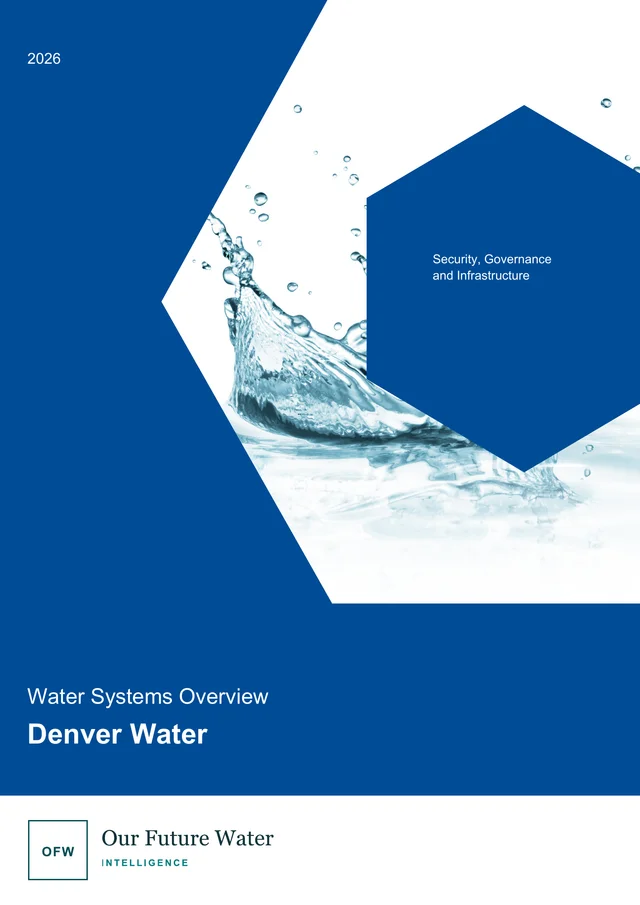
Use the project table, from the US$21 million Hazeltine pump station phase to lead line replacement under the 2026–2031 construction outlook, to see where work follows the Gross Reservoir dam raise.
Water resource and drought planners
Set Denver Water's 50% reliance on the Colorado River Basin against Reclamation's 2027–2036 Decision Framework and 2026 runoff of 22% of normal.
Municipal credit analysts
Weigh long-term debt of US$1,685.2 million in FY 2025, 3.6 times the FY 2016 level, against triple-A ratings affirmed in 2024 and a 23.0% rise in the 2027 fixed charge.
Water quality and lead program specialists
Compare 40,258 lead service lines replaced by October 31, 2026 with two published inventory estimates and lead at the 90th percentile of 4 ppb and 3.1 ppb in 2025.
03
Decision scope
Questions answered
How much of Denver Water's supply comes from the Colorado River Basin?
About 50%, with customers using about 125,000 acre-feet of West Slope water a year; the river's reservoirs will be operated under Reclamation's 2027–2036 Decision Framework.
How severe was the 2026 drought for Denver Water?
Natural streamflow into its reservoirs in April–July 2026 was 95,000 acre-feet, 22% of normal, and storage was 72% full on August 24, 2026 against a historic median of 94%.
When will the Gross Reservoir Expansion be finished?
The dam raise topped out on June 3, 2026, and completion is now given as 2028; filling of the added 77,000 acre-feet depends on water availability.
Who sets Denver Water's rates?
Its five-member Board of Water Commissioners, appointed by the Mayor of Denver, which approved 2027 rates on October 28, 2026, raising the fixed charge by US$4.81 to US$25.72 a month.
Is treatment capacity a constraint?
Not on these figures: average treated water consumption in FY 2025 was 183.8 MGD, 30.6% of the 600 MGD listed capacity (calculated).
04
Inside the report
Inside the complete report
Executive Overview
1. Water Resource Profile
2. Governance and Institutional Framework
3. Infrastructure and Service Delivery
Strategic Outlook and Opportunities
Source Register
05
Public preview
What to watch next
Strategic Outlook and Opportunities
The FY 2026 audited report and the size of any reserve draw; any rating action after 2024; Gross Reservoir finishing works and first filling; Hazeltine filling (due in 2026) and North Complex gravity infrastructure (expected by the end of 2026); an advanced metering award; a refreshed 10-year capital plan figure; publication of results against the 2025 emissions and energy targets.
2. Governance and Institutional Framework
Board action on restrictions and drought pricing before April 30, 2027; Board President Tyrone Gant's term, which expires in 2027; how Reclamation's framework is applied in the first operating years from 2027; any rating action after the drought year.
1. Water Resource Profile
Storage at the start of the 2027 runoff season; whether the Board extends Stage 1 measures beyond April 30, 2027; first filling of the expanded Gross Reservoir; the new Integrated Resource Plan (Strategic Outlook).
3. Infrastructure and Service Delivery
Break counts and replacement footage in the FY 2026 audited report; the calendar 2026 water quality report, including whether the Moffat sampling requirement is met; annual lead replacement totals; an advanced metering procurement decision.
Projects and programs with scope, value and status as of November 21, 2026, and the FY 2016–FY 2025 financial series, from the Strategic Outlook.
06
Included
What you receive
The complete PDF report: 14 pages, 6 sections, 21 tables and a register of 29 sources.
This edition
November 2026, First edition.
07
Evidence & method
Evidence and method
Denver Water's audited annual financial reports for FY 2016–FY 2025, water quality reports for calendar 2022–2025, Board resolutions and rate pages; its project, drought and planning pages; federal decisions from EPA, the U.S. Bureau of Reclamation and the 10th Circuit; and 2025–2026 bond, trade and news reports on projects and financing.
Sources
29 sources, listed in the report's source register. Evidence current to 21 November 2026. Principal data periods: FY 2016–FY 2025 audited results (years ended December 31; FY 2024 not included); calendar 2022–2025 drinking water quality data; 2026 and 2027 rates; 2026 drought measures; project, legal and program status checked to November 21, 2026. All currency is US dollars.
Evidence boundaries
This report uses authoritative source material available at the stated research cutoff. It distinguishes published facts, calculated values and analytical interpretation. No independent modelling is performed. Forward-looking analysis reflects published plans, documented trends and stated uncertainties. It does not constitute legal, financial, investment or engineering advice.
08
Lead analyst
Robert C. Brears
Founder, Our Future Water Intelligence
Robert C. Brears is a water-security specialist and author whose work examines utility governance, infrastructure investment, climate resilience and long-term water-system change for executive and policy audiences.
- Decision-focused utility intelligence
- Published water-policy author
- Evidence-grounded system analysis
09
Buyer FAQs
Before you purchase
Who can use the report?
Licensed for internal use within one purchasing organization. The PDF and its contents may be shared with colleagues within that organization. External redistribution, resale and public publication are prohibited without permission.
How is the report delivered?
The PDF is available to download immediately after confirmed payment, through our secure delivery system.
Can my organization buy wider access?
Institutional purchasing: For invoice enquiries, multi-organization licensing or broader access requirements, contact Our Future Water Intelligence.
10
Water Systems Overview: Denver Water
- Format
- Length
- 14 pages
- Edition
- November 2026, First edition
- Price
- USD 499
11
Report details
Publication details
- Publisher
- Our Future Water Intelligence
- Report family
- Water Utility Intelligence Report
- Edition
- November 2026, First edition
- Format
- Length
- 14 pages
- Reference
- OFW_EXT_WATER_SYSTEMS_OVERVIEW_DENVER_WATER_a58055824e93
- Evidence current to
- 21 November 2026
14
Explore this report family
More Water Systems Overview reports
Explore the same report family covering other utilities.
Water Systems Overview: Thames Water
- Geography
- London and the Thames Valley, England
- Edition
- November 2026 edition
- Length
- 15 pages
Water Systems Overview: Austin Water
- Geography
- Austin and surrounding areas, Texas, United States
- Edition
- November 2026, First edition
- Length
- 14 pages
Water Systems Overview: San Diego County Water Authority
- Geography
- San Diego County, California, United States
- Edition
- November 2026, First edition
- Length
- 15 pages