
01
Executive overview
Key findings
179 mm: rainfall in Jeddah on 24 November 2022, "the highest amount ever received in the city" (National Center of Meteorology, reported by Arab News)
46%: share of the city covered by completed or in-progress stormwater projects at end-2024; targets are 75% by 2028 and 100% by 2033
About USD 175 million per phase: KAFA stormwater tunnel phases 1–2, contractor selected in 2025, agreement unsigned as of August 2026
613.9–2,216.5 km²: national coastal area that a 1–3 m sea-level rise could submerge; Jeddah is named with Al Wajh and Jazan as the major Saudi coastal cities vulnerable to sea-level rise (NC4, citing Hereher 2020)
02
Buyer relevance
Who the report is for
Drainage, tunnelling and pumping contractors
Follow the Prince Fawaz, Old Zahraa and KAFA procurements that decide whether coverage moves from 46% towards 75% by 2028.
Climate risk and insurance analysts
Use the 179 mm event, the 2018 station rainfall of 86.4 mm and the national sea-level scenarios as the published basis for Jeddah flood exposure.
Water utility and desalination investors
Separate Jeddah's rainfall-independent desalinated supply from its flood and coastal exposure when assessing asset risk.
03
Decision scope
Questions answered
Is Jeddah exposed to drought?
Its primary supply is desalinated seawater, which does not depend on rainfall; the documented hazard is flash flooding, such as the 179 mm that fell on 24 November 2022.
How much of Jeddah is protected by storm drainage?
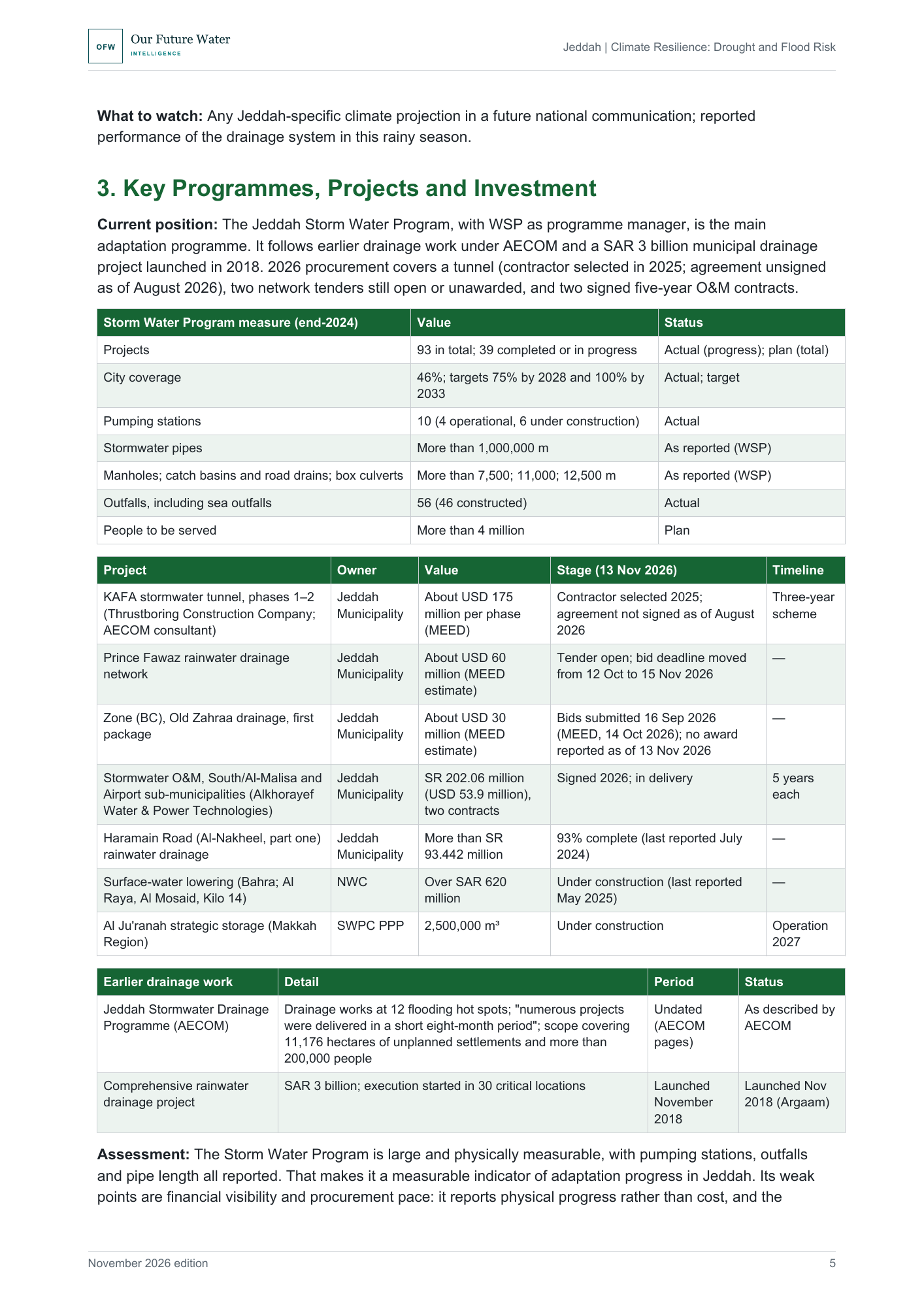
Completed or in-progress stormwater projects covered 46% of the city at end-2024, with targets of 75% by 2028 and 100% by 2033.
What drainage contracts are pending?
The KAFA tunnel (about USD 175 million per phase) awaits a signed agreement, Prince Fawaz drainage bids (about USD 60 million) close on 15 November 2026, and an Old Zahraa package (about USD 30 million) had bids submitted on 16 September 2026.
Is Jeddah vulnerable to sea-level rise?
Saudi Arabia's Fourth National Communication names Jeddah with Al Wajh and Jazan as the major vulnerable coastal cities; nationally a 1–3 m rise could submerge 613.9–2,216.5 km².
04
Inside the report
Inside the complete report
Executive Snapshot
1. Why This Matters Now in Jeddah
2. Current Position
3. Key Programmes, Projects and Investment
4. Policy, Regulation and Institutions
5. Risks and Constraints
6. Strategic Implications
7. What to Watch
Source Register
05
Public preview
What to watch next
3. Key Programmes, Projects and Investment
The Prince Fawaz and Old Zahraa awards; KAFA signature; any updated coverage figure from the programme.
5. Risks and Constraints
Any published flood damage or service disruption after the 2026–2027 rainy season; any Jeddah-specific climate study.
2. Current Position
Any Jeddah-specific climate projection in a future national communication; reported performance of the drainage system in this rainy season.
4. Policy, Regulation and Institutions
A national adaptation document naming Jeddah measures; reconciliation of the net-zero years in SWA's next sustainability report.
Jeddah Storm Water Program measures and current drainage contracts, with value, stage and timeline.
06
Included
What you receive
The complete PDF report: 10 pages, 9 sections, 9 tables and a register of 15 sources.
This edition
November 2026, First edition.
07
Evidence & method
Evidence and method
The report draws on Saudi Arabia's Fourth National Communication to the UNFCCC, National Center of Meteorology statements reported by Arab News, the Jeddah Storm Water Program's published progress, MEED contract and tender reporting, and Saudi Water Authority and National Water Company sources, with procurement statuses re-checked on 13 November 2026.
Sources
15 sources, listed in the report's source register. Evidence current to 13 November 2026. Principal data periods: rainfall event of 24 November 2022; Jeddah-KAIA station observations for 2018; stormwater programme progress to end-2024 and contract status as of 13 November 2026; national climate reporting to the UNFCCC (March 2022). Currency is Saudi riyals (SAR) unless stated; US dollar values are given as published..
Evidence boundaries
This report uses authoritative source material available at the stated research cutoff. It distinguishes published facts, calculated values and analytical interpretation. No independent modelling is performed. Forward-looking analysis reflects published plans, documented trends and stated uncertainties. It does not constitute legal, financial, investment or engineering advice.
08
Lead analyst
Robert C. Brears
Founder, Our Future Water Intelligence
Robert C. Brears is a water-security specialist and author whose work examines utility governance, infrastructure investment, climate resilience and long-term water-system change for executive and policy audiences.
- Decision-focused utility intelligence
- Published water-policy author
- Evidence-grounded system analysis
09
Buyer FAQs
Before you purchase
Who can use the report?
Licensed for internal use within one purchasing organization. The PDF and its contents may be shared with colleagues within that organization. External redistribution, resale and public publication are prohibited without permission.
How is the report delivered?
The PDF is available to download immediately after confirmed payment, through our secure delivery system.
Can my organization buy wider access?
Institutional purchasing: For invoice enquiries, multi-organization licensing or broader access requirements, contact Our Future Water Intelligence.
10
Climate Resilience: Drought and Flood Risk in Jeddah
- Format
- Length
- 10 pages
- Edition
- November 2026, First edition
- Price
- USD 249
11
Report details
Publication details
- Publisher
- Our Future Water Intelligence
- Report family
- Insight Brief
- Edition
- November 2026, First edition
- Format
- Length
- 10 pages
- Reference
- OFW_EXT_CLIMATE_RESILIENCE_DROUGHT_AND_FLOOD_RISK_IN_JEDDAH_cf3ea83dd347
- Evidence current to
- 13 November 2026
14
Explore this report family
More Climate Resilience: Drought and Flood Risk briefs
Explore the same report family covering other cities.
Climate Resilience: Drought and Flood Risk in Abu Dhabi
- Geography
- United Arab Emirates
- Edition
- November 2026, First edition
- Length
- 9 pages
Climate Resilience: Drought and Flood Risk in Amsterdam
- Geography
- Netherlands
- Edition
- November 2026, First edition
- Length
- 11 pages
Climate Resilience: Drought and Flood Risk in Copenhagen
- Geography
- Denmark
- Edition
- November 2026, First edition
- Length
- 10 pages