
01
Executive overview
Key findings
665,000 m³/day: Shuaiba-5 desalination output after an 11% uplift above its 600,000 m³/day design (SWA, February 2026); it serves the Makkah Region
600,000 m³/day: Rabigh 4, reported online at full capacity (ACWA Power, Q1 2026); SWPC still lists it as under construction
335 MCM to 779 MCM: modelled Jeddah water demand, 2017 to 2030 (academic projection, base case)
More than 20%: leakage in Jeddah's distribution system (NWC, 2017), the latest city figure
02
Buyer relevance
Who the report is for
Desalination developers and PPP investors
Track the plants on the Rabigh–Jeddah–Makkah corridor, from Shuaibah 3.1 (2009) to Rabigh 5 (planned for 2030), with capacity and stage.
Network, metering and leak-detection suppliers
Use the 2017 leakage figure of more than 20% and the 2020 Smart Zones project as the Jeddah baseline for loss-reduction offers.
Risk and sovereign analysts
Separate regional capacity, city distribution and national targets when assessing Jeddah's exposure to plant, energy and transmission risk.
03
Decision scope
Questions answered
Where does Jeddah's water come from?
Desalinated Red Sea seawater from coastal plants such as Shuaiba-5 (665,000 m³/day) and Shuaibah 3 Conversion (600,000 m³/day), moved through the RJM system, which can supply the Makkah Region with up to 1.3 million m³/day.
Will Jeddah have enough water by 2030?
The only Jeddah projection is an academic model: demand rising from 335 MCM to 779 MCM, with a 2030 gap of 504 MCM that falls to 101 MCM with conservation and leakage cut to 10%. The model predates the 2024–2026 capacity additions.
What new supply is coming?
Shoaiba 6, about 500,000 m³/day, under construction since 29 October 2025, and Rabigh 5, 400,000 m³/day, planned for 2030; Al Ju'ranah adds 2,500,000 m³ of regional storage in 2027.
How much water does Jeddah lose?
More than 20% in its distribution system, including illegal connections, according to NWC's 2017 figure, the latest for the city.
04
Inside the report
Inside the complete report
Executive Snapshot
1. Why This Matters Now in Jeddah
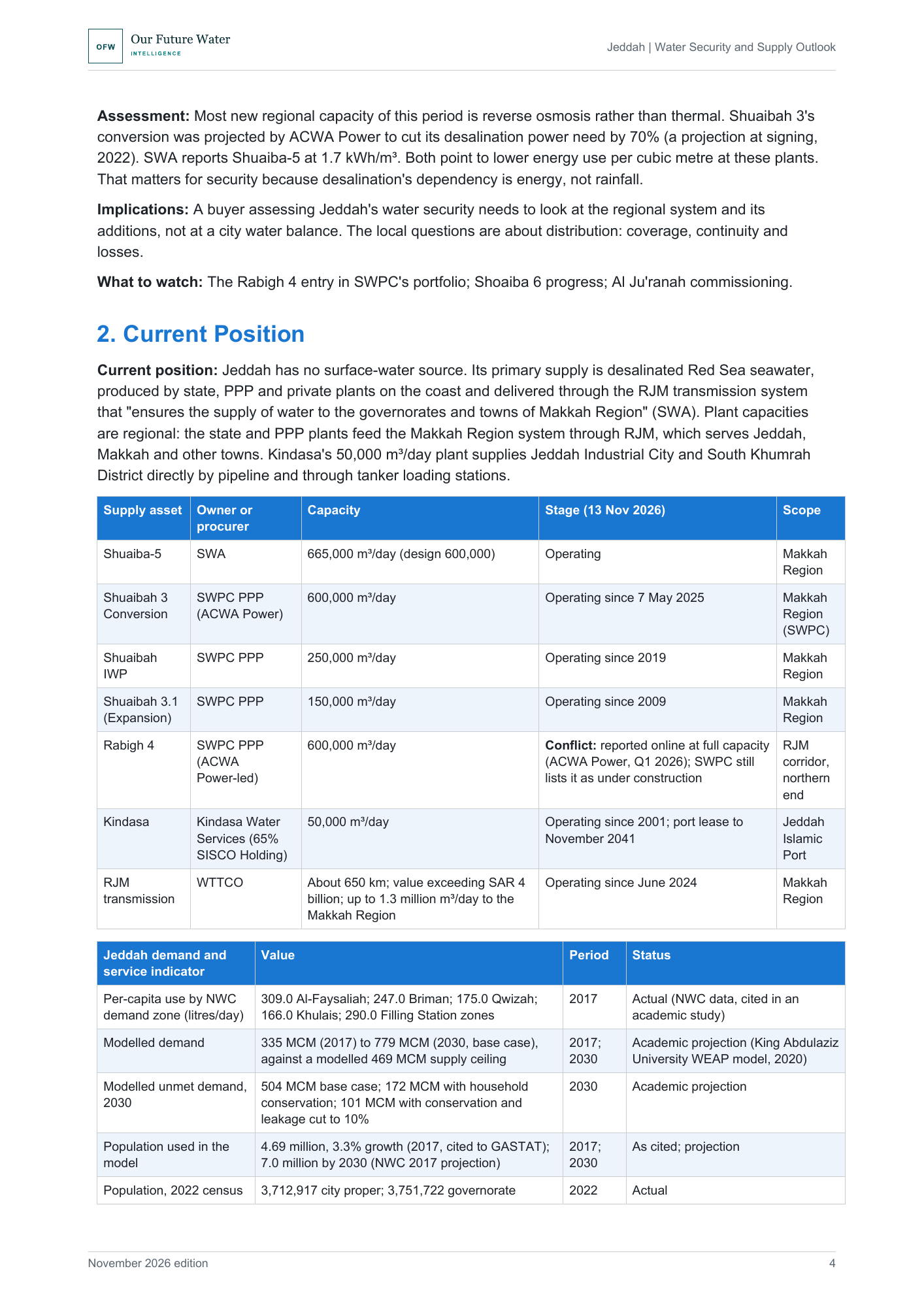
2. Current Position
3. Key Programmes, Projects and Investment
4. Policy, Regulation and Institutions
5. Risks and Constraints
6. Strategic Implications
7. What to Watch
Source Register
05
Public preview
What to watch next
3. Key Programmes, Projects and Investment
Shoaiba 6 completion date; Rabigh 5 procurement; an NRW Phase 2; any Jeddah reuse contract.
4. Policy, Regulation and Institutions
Consumption data after the 2027 tariffs; SWA's next loss-reduction figure and its base.
1. Why This Matters Now in Jeddah
The Rabigh 4 entry in SWPC's portfolio; Shoaiba 6 progress; Al Ju'ranah commissioning.
2. Current Position
An updated leakage figure; SWA's next national production figure on a consistent definition.
Supply assets serving Jeddah, with owner, capacity, stage and scope, and the city's demand and service indicators.
06
Included
What you receive
The complete PDF report: 11 pages, 9 sections, 9 tables and a register of 34 sources.
This edition
November 2026, First edition.
07
Evidence & method
Evidence and method
The report draws on Saudi Water Authority and Saudi Press Agency statements on plants and transmission, the Saudi Water Partnership Company portfolio, a King Abdulaziz University demand model using NWC data, GASTAT water accounts and trade reporting from MEED, MEES and Argaam, with plant stages re-checked on 13 November 2026.
Sources
34 sources, listed in the report's source register. Evidence current to 13 November 2026. Principal data periods: plant and project status as of 13 November 2026; Jeddah demand, consumption and leakage data for 2017 and the academic projection to 2030; network coverage and continuity as of January 2020; national water accounts for 2022–2023 and sector data for 2025. Currency is Saudi riyals (SAR) unless stated; US dollar values are given as published..
Evidence boundaries
This report uses authoritative source material available at the stated research cutoff. It distinguishes published facts, calculated values and analytical interpretation. No independent modelling is performed. Forward-looking analysis reflects published plans, documented trends and stated uncertainties. It does not constitute legal, financial, investment or engineering advice.
08
Lead analyst
Robert C. Brears
Founder, Our Future Water Intelligence
Robert C. Brears is a water-security specialist and author whose work examines utility governance, infrastructure investment, climate resilience and long-term water-system change for executive and policy audiences.
- Decision-focused utility intelligence
- Published water-policy author
- Evidence-grounded system analysis
09
Buyer FAQs
Before you purchase
Who can use the report?
Licensed for internal use within one purchasing organization. The PDF and its contents may be shared with colleagues within that organization. External redistribution, resale and public publication are prohibited without permission.
How is the report delivered?
The PDF is available to download immediately after confirmed payment, through our secure delivery system.
Can my organization buy wider access?
Institutional purchasing: For invoice enquiries, multi-organization licensing or broader access requirements, contact Our Future Water Intelligence.
10
Water Security and Supply Outlook in Jeddah
- Format
- Length
- 11 pages
- Edition
- November 2026, First edition
- Price
- USD 249
11
Report details
Publication details
- Publisher
- Our Future Water Intelligence
- Report family
- Insight Brief
- Edition
- November 2026, First edition
- Format
- Length
- 11 pages
- Reference
- OFW_EXT_WATER_SECURITY_AND_SUPPLY_OUTLOOK_IN_JEDDAH_13e3151daad5
- Evidence current to
- 13 November 2026
14
Explore this report family
More Water Security and Supply Outlook briefs
Explore the same report family covering other cities.
Water Security and Supply Outlook in Abu Dhabi
- Geography
- United Arab Emirates
- Edition
- November 2026, First edition
- Length
- 11 pages
Water Security and Supply Outlook in Amsterdam
- Geography
- Netherlands
- Edition
- November 2026, First edition
- Length
- 10 pages
Water Security and Supply Outlook in Copenhagen
- Geography
- Denmark
- Edition
- November 2026, First edition
- Length
- 10 pages