
01
Executive overview
Key findings
3.59 million m³ a day: peak water demand on the EWEC system in 2023, including 0.25 exported to the Northern Emirates (actual)
4.74 vs 4.14 million m³ a day: installed production capacity in 2023, as given in two places in the same regulator report (actual; conflicting)
0.0078%: share of 2023 supply not delivered because of transmission interruptions, against a KPI below 0.05% (actual)
Over 2 million m³ a day: water capacity reaching contract expiry in 2024–2037 (EWEC projection)
02
Buyer relevance
Who the report is for
Water planners and regulators
Compare the two installed-capacity figures and the calculated 15% or 32% margin over 2023 peak demand when testing supply adequacy.
Desalination developers and RO suppliers
See why EWEC recommends at least 0.28 million m³ a day more RO by 2029 and which named plants could supply it.
Lenders and insurers with Gulf utility exposure
Weigh the 0.0078% supply-interruption figure against the 2026 regional security incidents and coastal intake exposure.
Agricultural and groundwater stakeholders
Track the DoE target to cut groundwater abstraction by 500 million m³ by 2030, with measures for half already identified.
03
Decision scope
Questions answered
Does Abu Dhabi have enough desalination capacity?
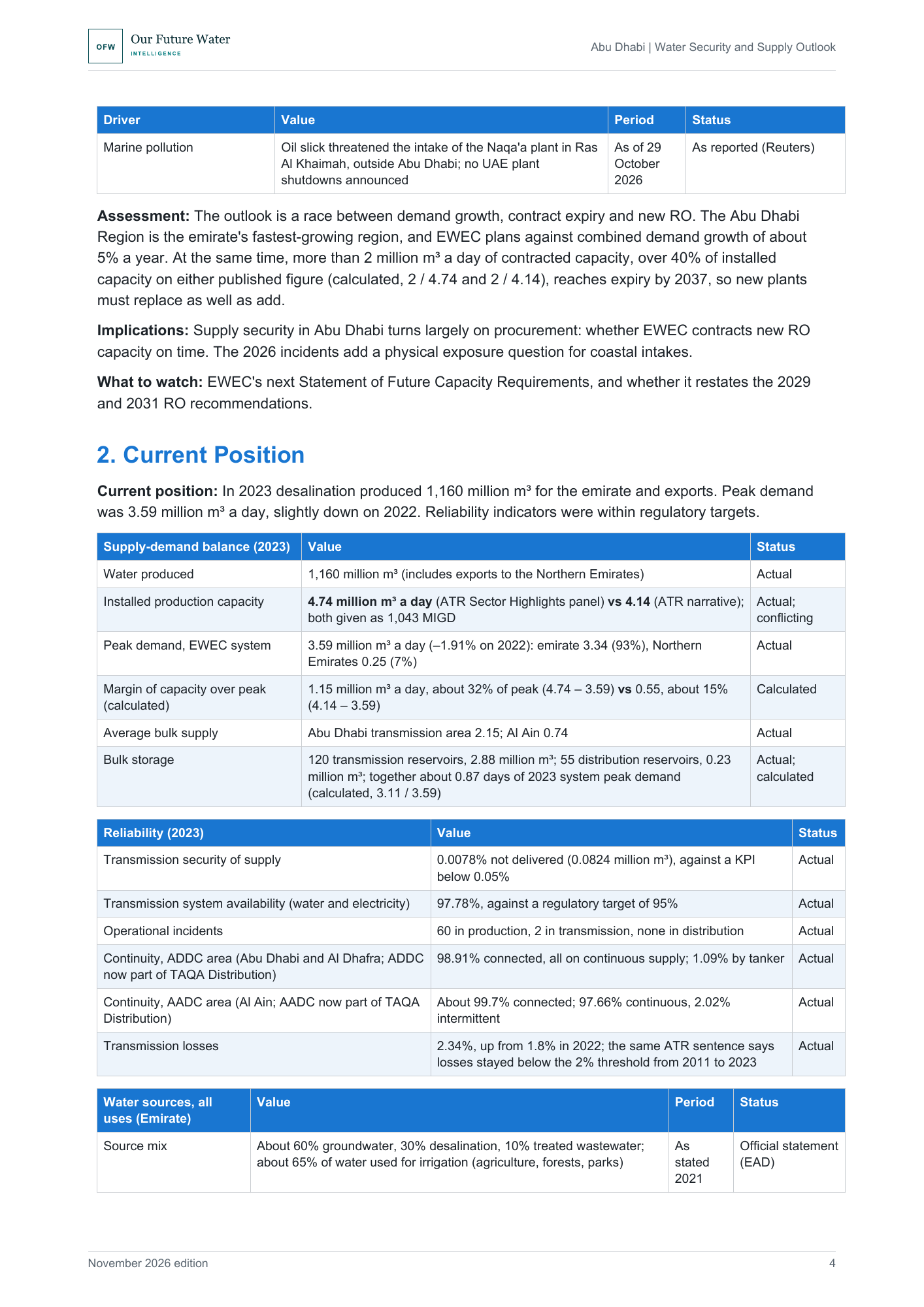
Peak demand was 3.59 million m³ a day in 2023 against installed capacity of 4.74 or 4.14 million m³ a day, a margin of about 32% or 15% (calculated).
How much capacity must be replaced?
EWEC projects that over 2 million m³ a day of water capacity reaches contract expiry between 2024 and 2037, while combined power and water demand grows about 5% a year to 2035.
What new supply is coming?
Mirfa 2 and Shuweihat 4 add about 0.86 million m³ a day; EWEC plans RO capacity of more than 3.5 million m³ a day serving over 92% of projected demand by 2031.
How reliable was supply in 2023?
Transmission interruptions cost 0.0078% of supply against a KPI below 0.05%, and all connected customers in the ADDC area (now part of TAQA Distribution) were on continuous supply.
04
Inside the report
Inside the complete report
Executive Snapshot
1. Why This Matters Now in Abu Dhabi
2. Current Position
3. Key Programmes, Projects and Investment
4. Policy, Regulation and Institutions
5. Risks and Constraints
6. Strategic Implications
7. What to Watch
Source Register
05
Public preview
What to watch next
1. Why This Matters Now in Abu Dhabi
EWEC's next Statement of Future Capacity Requirements, and whether it restates the 2029 and 2031 RO recommendations.
2. Current Position
The DoE's next Annual Technical Report: whether it reconciles the capacity figures and whether transmission losses return below 2%.
3. Key Programmes, Projects and Investment
Shuweihat 4 commercial operation; the next EWEC RO request for proposals.
4. Policy, Regulation and Institutions
DoE approval of EWEC's next RO procurement; the proposed Abu Dhabi Water Balance Sheet Policy, which the DoE chairman has directed be prepared.
Section 2: the 2023 supply-demand balance, reliability indicators and water sources, with the two conflicting capacity figures shown side by side.
06
Included
What you receive
The complete PDF report: 11 pages, 9 sections, 10 tables and a register of 22 sources.
This edition
November 2026, First edition.
07
Evidence & method
Evidence and method
The brief draws on the Department of Energy's 2023 Annual Technical Report, EWEC's Statement of Future Capacity Requirements and plant pages, SCAD population data, EAD and DoE groundwater and strategy releases, the UAE national climate communication, and project and security reporting checked to 11 November 2026.
Sources
22 sources, listed in the report's source register. Evidence current to 11 November 2026. Principal data periods: 2023 supply, demand and reliability data (Department of Energy Annual Technical Report); EWEC capacity outlook to 2037; project status as of 11 November 2026. Units: million m³ a day unless stated. Currency: UAE dirham (AED)..
Evidence boundaries
This report uses authoritative source material available at the stated research cutoff. It distinguishes published facts, calculated values and analytical interpretation. No independent modelling is performed. Forward-looking analysis reflects published plans, documented trends and stated uncertainties. It does not constitute legal, financial, investment or engineering advice.
08
Lead analyst
Robert C. Brears
Founder, Our Future Water Intelligence
Robert C. Brears is a water-security specialist and author whose work examines utility governance, infrastructure investment, climate resilience and long-term water-system change for executive and policy audiences.
- Decision-focused utility intelligence
- Published water-policy author
- Evidence-grounded system analysis
09
Buyer FAQs
Before you purchase
Who can use the report?
Licensed for internal use within one purchasing organization. The PDF and its contents may be shared with colleagues within that organization. External redistribution, resale and public publication are prohibited without permission.
How is the report delivered?
The PDF is available to download immediately after confirmed payment, through our secure delivery system.
Can my organization buy wider access?
Institutional purchasing: For invoice enquiries, multi-organization licensing or broader access requirements, contact Our Future Water Intelligence.
10
Water Security and Supply Outlook in Abu Dhabi
- Format
- Length
- 11 pages
- Edition
- November 2026, First edition
- Price
- USD 249
11
Report details
Publication details
- Publisher
- Our Future Water Intelligence
- Report family
- Insight Brief
- Edition
- November 2026, First edition
- Format
- Length
- 11 pages
- Reference
- OFW_EXT_WATER_SECURITY_AND_SUPPLY_OUTLOOK_IN_ABU_DHABI_20a246914b85
- Evidence current to
- 11 November 2026
14
Explore this report family
More Water Security and Supply Outlook briefs
Explore the same report family covering other cities.
Water Security and Supply Outlook in Amsterdam
- Geography
- Netherlands
- Edition
- November 2026, First edition
- Length
- 10 pages
Water Security and Supply Outlook in Copenhagen
- Geography
- Denmark
- Edition
- November 2026, First edition
- Length
- 10 pages
Water Security and Supply Outlook in Hamburg
- Geography
- Germany
- Edition
- November 2026, First edition
- Length
- 10 pages